
Views: 0 Author: Site Editor Publish Time: 2025-12-15 Origin: Site


When selecting a fan for industrial, commercial, or residential applications, understanding the differences in fan types is crucial for optimizing performance and meeting system requirements. One fan type that stands out in terms of efficiency and versatility is the centrifugal blower fan. This article will delve into what makes centrifugal blower fans distinct from other fan types, their unique working mechanisms, and their key advantages for a wide range of applications.
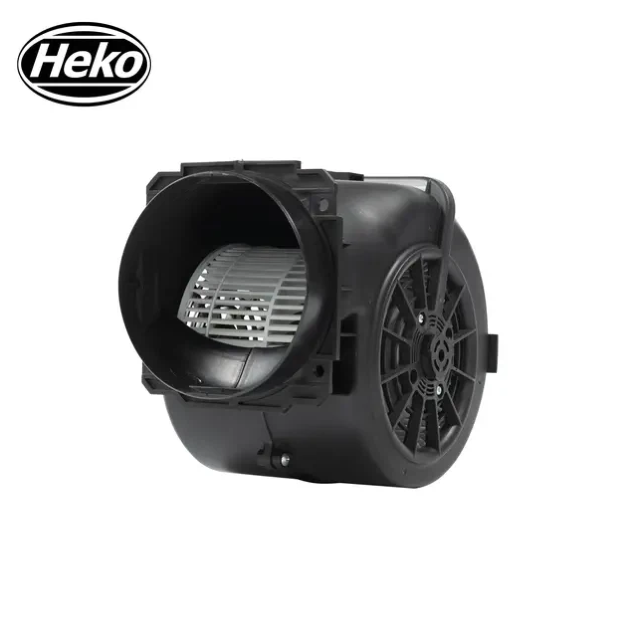
Centrifugal blower fans operate based on a simple yet highly effective design. These fans draw air into the fan via the center of the unit (inlet) and then force it out at a 90-degree angle through a duct or an exhaust system. This design is achieved using an impeller, which spins rapidly inside a scroll housing, creating a high-pressure airflow that is expelled at the outlet. The speed and pressure of the air increase as it moves through the system, making centrifugal fans an ideal choice for systems requiring high static pressure.
One of the primary benefits of the centrifugal design is its ability to maintain airflow stability, even in environments where resistance to airflow is high. In systems with extensive ductwork or filters, centrifugal blower fans are particularly effective at maintaining consistent air pressure and volume, something that other fan types might struggle with.
Heko's centrifugal blower fans come in single and double inlet options, catering to different system needs. The fans are available with both AC and DC input options, allowing for flexibility in various applications. Moreover, the use of 3-core EC brushless external rotor motors ensures high efficiency and durability across all product sizes, including 97mm, 108mm, 120mm, 140mm, and 160mm for DC single inlet models, and 133mm and 146mm for double inlet models.
One of the main differences between centrifugal blower fans and axial fans lies in the direction of airflow and the resulting pressure. Centrifugal fans move air perpendicularly, which generates higher static pressure. This makes them ideal for systems that need to move air through long ducts, filters, or systems that resist airflow.
On the other hand, axial fans create a straight path for the airflow, which results in lower static pressure and is more suited to applications where air can flow freely without encountering much resistance, such as cooling large open spaces or ventilation in areas with minimal ducting.
Centrifugal fans excel in environments where airflow meets resistance, such as in ducted systems. Their design allows them to maintain pressure and airflow even as resistance increases, making them ideal for HVAC systems, fume extraction, and other industrial applications requiring powerful airflow through complex systems.
In contrast, axial fans perform best in situations where air moves with minimal resistance. Their direct airflow path makes them less effective in systems that involve long ductwork or obstacles.
Another significant distinction is the size and noise levels of centrifugal blower fans compared to axial fans. Centrifugal blowers typically have larger housings designed to optimize static pressure. While they are often bigger, they are engineered for stability, and their noise levels are generally consistent, making them suitable for environments that require precision and durability.
Axial fans, due to their more straightforward design, are often lighter and smaller. They can be more cost-effective for less demanding applications, but they may produce more noise when under load.
Inline fans are a compact solution for ventilation systems, often used in smaller spaces where size constraints are a factor. They are quieter and simpler in design, making them ideal for applications like bathroom or kitchen ventilation. However, inline fans lack the capacity to generate the same level of static pressure as centrifugal fans, which means they are less effective in complex ducted systems where resistance is a concern.
Positive displacement fans and other specialty fans serve more niche applications, such as providing a constant flow of air regardless of changes in pressure. While these fans have their place in specialized industries, centrifugal blower fans offer broader versatility, providing reliable and consistent airflow across a variety of industrial and commercial settings.
Choosing between centrifugal, axial, inline, or positive displacement fans depends on specific system requirements. If high static pressure is necessary, as in the case of complex HVAC or industrial systems, centrifugal blower fans are the best choice. For applications with minimal airflow resistance, such as in open spaces or simple cooling systems, axial fans might be more efficient and cost-effective.
One of the most significant advantages of centrifugal blower fans is their ability to generate high static pressure. This makes them invaluable in systems with long ductwork, multiple filters, or complex air handling processes. Whether you're dealing with HVAC systems, industrial filtration, or exhaust systems, centrifugal fans can maintain consistent airflow and pressure even in challenging conditions.
Centrifugal fans are designed to offer better control and directionality of airflow. This is particularly important in environments that require precise air movement, such as laboratories, clean rooms, or industrial manufacturing processes. The ability to direct airflow with high precision ensures the effectiveness of air purification, cooling, or ventilation systems.
From HVAC and refrigeration systems to industrial exhaust systems and material handling, centrifugal blower fans are incredibly versatile. They can handle a wide range of applications, including dust collection, fume extraction, and drying systems, making them an essential component in many industries, including electronics, manufacturing, and automotive.
When it comes to choosing a centrifugal blower fan for your system, Heko centrifugal blower fans stand out due to their high performance, durability, and flexibility. With options ranging from single inlet to double inlet, and the ability to handle both AC and DC inputs, Heko offers fans that can seamlessly integrate into a variety of systems.
The 3-core EC brushless external rotor motors used in Heko centrifugal fans ensure energy efficiency, longevity, and low maintenance, making them an ideal choice for both commercial and industrial applications. Whether you're designing a new HVAC system, improving an existing ventilation solution, or setting up a complex air filtration process, Heko's centrifugal blower fans provide reliable performance.
In conclusion, centrifugal blower fans provide superior performance in applications that demand high static pressure and consistent airflow, especially when compared to other fan types like axial or inline fans. By offering stable performance under resistance, precision control, and flexibility in various industries, centrifugal fans are the go-to solution for complex ventilation, exhaust, and air handling systems.
If you're looking for a reliable and efficient centrifugal blower fan, Heko's range of products offers the performance, flexibility, and durability your system requires. Contact us today to learn more about how our centrifugal blower fans can help optimize your systems and meet your specific air handling needs.
What is a centrifugal blower fan used for?
A centrifugal blower fan is used in various industries for applications that require high static pressure, such as HVAC systems, air filtration, and industrial exhaust systems. It is particularly effective in ducted systems and areas with resistance.
How do centrifugal blower fans compare to axial fans?
Centrifugal blower fans generate higher static pressure and are ideal for systems with ductwork or filters, whereas axial fans provide lower static pressure and are best for open ventilation systems with minimal resistance.
What sizes are available for centrifugal blower fans?
Heko's centrifugal blower fans are available in sizes ranging from 97mm to 180mm for single inlet models, and 133mm to 146mm for double inlet models. These size options allow flexibility in system design and integration.
Why should I choose Heko centrifugal blower fans?
Heko centrifugal blower fans are known for their high efficiency, durability, and versatility. With options for AC and DC input, as well as brushless external rotor motors, Heko fans offer reliable performance in demanding applications.


